

MOFs are awarded the long-awaited Nobel Prize
Nobel Prize for the development of metal-organic frameworks
‘Well deserved’ and ‘It was only a matter of time’. That, in a nutshell, is the reaction from the MOF community to today’s award of the Nobel Prize to Susumu Kitagawa, Richard Robson and Omar Yaghi for the development of metal-organic frameworks. ‘Thanks to Kitagawa and Yaghi, I’m never bored.’
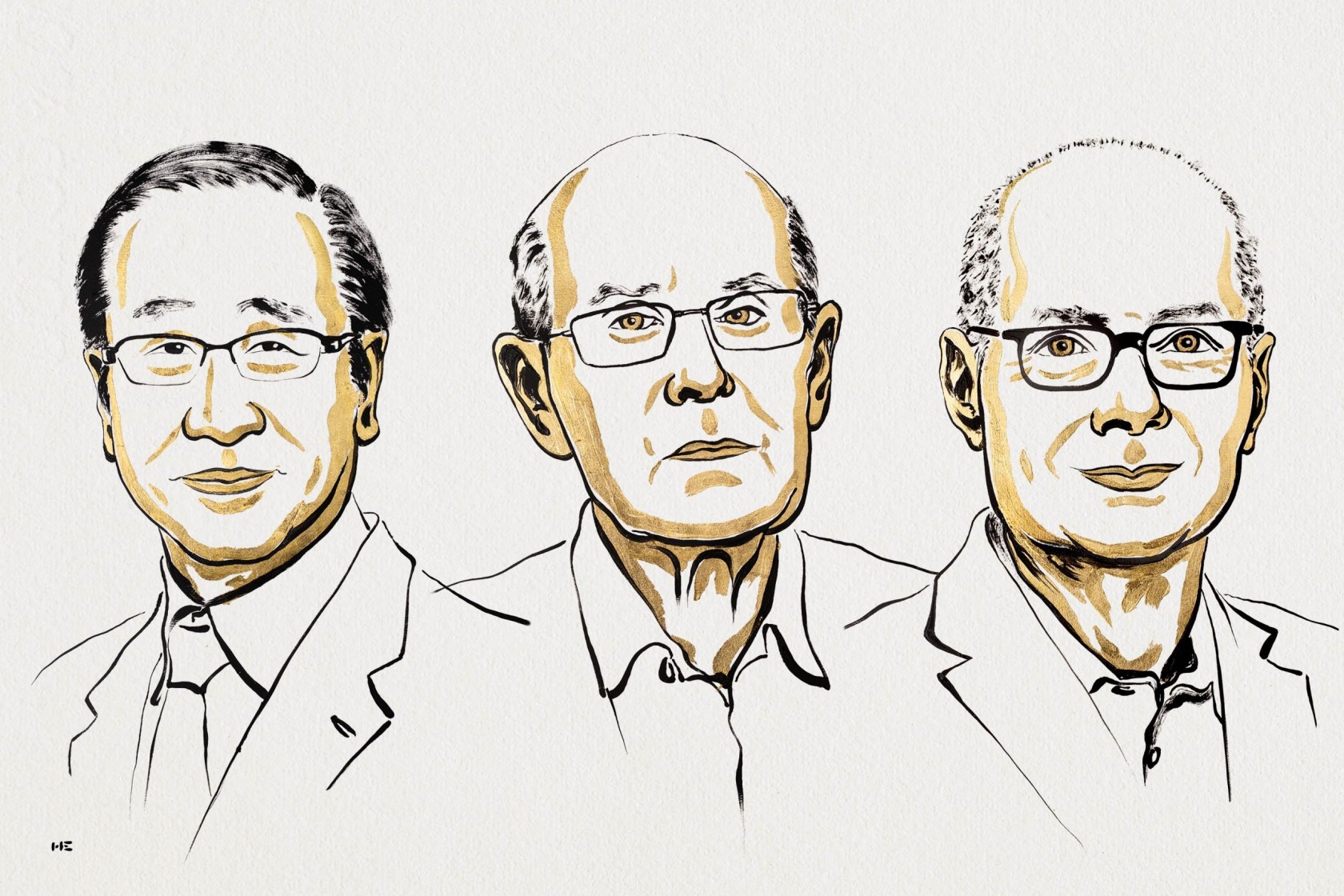
‘This is a choice that does credit to the MOF field,’ says Freek Kapteijn, emeritus professor of Catalysis Engineering at Delft University of Technology. ‘Robson laid the foundations, Kitagawa expanded on them and provided the fundamental underpinnings, and Yaghi explored the applications. The result is an entirely new field in which you can use organic and inorganic building blocks to create an infinite variety of materials for a wide range of applications.’
Kapteijn’s reaction is echoed by all the chemists C2W | Mens & Molecule spoke to this afternoon. ‘It’s a wonderful day for the MOF community,’ says Stefania Grecea, associate professor at HIMS/University of Amsterdam. ‘Personally, I’m not surprised that Yaghi is receiving the prize; it was only a matter of time.’ And it simply takes time before you can properly assess the impact of a scientific discovery, according to Grecea. ‘MOFs have been around for decades, but a new field needs time to develop and mature before we start to see its contribution to answering fundamental questions and begin to understand where the possibilities for applications lie.’
‘MOFs have been around for decades, but a new field needs time to develop and mature’
Stefania Grecea, HIMS/UvA
She highlights Yaghi’s contribution in paving the way for these applications. ‘Yaghi demonstrated, at laboratory scale, the use of MOFs in the storage and separation of gases. But to move from the laboratory to practical application and see how these materials behave under realistic conditions, another important step was needed: upscaling. That also turned out to be a long process.’ According to Grecea, the fact that this recognition is coming now is actually quite timely. ‘It comes at the right moment, because MOFs have shown that they play an essential role in addressing the challenges in the areas of climate, pollution and energy. Think of capturing and storing CO2 or removing toxic gases from the atmosphere and pollutants from water.’
Grecea’s colleague, Assistant Professor Amanda Garcia (HIMS/UvA), was delighted with the substance of the Nobel Prize presentation. ‘I was pleased to hear carbon capture mentioned during the broadcast, as that’s something I’m working on myself. It’s fantastic that the Nobel Prize has gone to this field. It’s an important recognition, because this type of material is going to be very important in chemistry.’ The fact that she isn’t working directly on MOFs herself doesn’t dampen her enthusiasm. ‘Many of my colleagues at HIMS, including Stefania Grecea and Sonja Pullen, are working on this, so I’m very excited for them.’
‘A well-deserved Nobel Prize for the well-deserved laureates; it’s great to see that recognition for the field’
Rob Ameloot, KU Leuven
Rob Ameloot, a professor at KU Leuven, also mentions the favourable timing. ‘At the moment, the applications of MOFs are really starting to emerge. For example, CO₂ capture, which I’m working on myself. BASF is currently building a pilot plant for these materials, and we are developing the measurements to assess the uptake of these materials under realistic conditions. Coincidentally, we published a paper in Nature Communications just last week on chemical sensors, which also relates to MOFs for measuring molecules very selectively.’ The Nobel news did not come as a surprise to him. ‘It had been on the cards for a while. And it’s a well-deserved Nobel Prize; it’s great to see that recognition for the field. They are also the rightful laureates; no one would dispute that they are the living pioneers.’
‘You can’t open a chemistry journal without coming across a MOF paper’
Berend Smit, EFPL
In that context, the name Gérard Férey, who passed away in 2017, comes up in several conversations. ‘Together with Kitagawa and Yaghi, Férey saw the potential of MOFs and together they opened up the field,’ says Berend Smit, professor at EFPL in Lausanne. And since then, it has really taken off. ‘You can’t open a chemistry journal without coming across a MOF paper. Two new MOFs are created every day, and have been for years. It’s such a vast field and such a fascinating one to work in; there are endless possibilities for creating new materials. And with the advent of AI and computational methods, that’s only set to increase. Thanks to Kitagawa and Yaghi, I’m never bored for a moment.’
Share this post!