
Mini-symposium: Innovations in Membrane Technology
Mini-symposium organised by the 'Chemische Kring Zwolle'
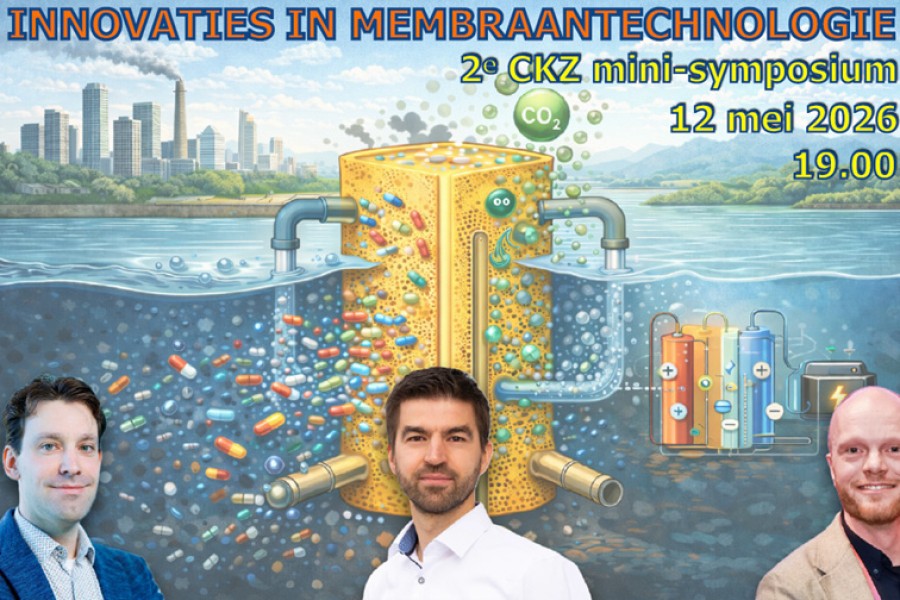
Mini-Symposium: Innovations in Membrane Technology
A foreword by the chair
Following last year’s success and at the request of several CKZ members, the board is organising another mini-symposium this year. Once again, it drew inspiration from the presentations available on eye-openers.nl, an initiative of the KNCV.
The board quickly settled on synthetic membranes as the central theme. Membranes generally receive little attention and are often seen as simple consumables. They are the Melitta filters of chemistry: ubiquitous, but rarely the subject of discussion when it comes to the quality of filter coffee. They deserve much more attention. Firstly, synthetic membranes almost always consist of polymers, which will appeal to many chemists in our region. Furthermore, membrane technologies are developing at a rapid pace, partly driven by environmental issues, the transition in energy and raw materials, and the challenges of climate change. From water purification to electrochemical conversion: membranes are increasingly playing a key role.
The board therefore believes it is high time that the CKZ devoted extra attention to membrane technology, not only to share knowledge, but also to rediscover just how innovative and versatile this seemingly modest field of materials is.
| Programme | |
| 19:00 | Opening by the Chair and introduction by moderator Koos van Baarzel |
| 19:30 | Lecture by Prof. Wiebe de Vos – Help, there are traces of medication in the water! |
| 20:00 | Lecture by Dr David A. Vermaas – How do you make sustainable fuel and plastics from air? |
| 20:30 | Lecture by Dr Jouke Dykstra – Electrochemical separation processes for raw material and water reuse |
| 21:00 | Panel discussion |
| 21:30 | Closing (with drinks) |
Our Moderator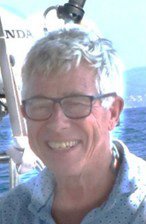 Koos van Baarzel, MSc, trained as a chemical engineer at Delft University of Technology (formerly Delft Technical University). He graduated in 1977 from the Department of Organic Chemistry under Professor Beyerman. I spent four years working on cyclopropanes and high-pressure chemistry at the University of Amsterdam under Prof. Dr Th. J. de Boer and H. Steinberg. Koos’ career continued at DSM Resins. There, he worked as a senior research chemist and product coordinator on unsaturated polyesters. He was responsible for project management, ISO certification, REACH dossiers for ‘small’ resins and process automation. Like a chemical detective, he did a great deal of troubleshooting and was involved in the design of experiments. In 2019, Koos retired.
The Mini-Symposium
1 Help, there are pharmaceutical residues in the water!
Speaker’s professional background
Prof. Dr Wiebe de Vos is Professor of Membrane Sciences at the University of Twente. Here, he combines his background in the fundamental field of surface chemistry with the more applied field of membrane technology. For example, he investigates how extremely thin polymer layers can be used to make membranes more selective, efficient and smarter, and has developed various methods to produce membranes in a more environmentally friendly way.
Summary of the lecture
New contaminants such as pharmaceutical residues, microplastics and PFAS are being found in ever-increasing quantities in our surface water and even in our drinking water sources. It is important to develop new separation methods to remove these substances efficiently, ideally before they enter our environment. In this talk, Prof. De Vos will discuss how new membrane materials, with unique separation properties, can lead to new treatment concepts that are already being tested on a pilot scale within wastewater treatment.
2 How do you make sustainable fuel and plastics from air?
Speaker’s professional background
Dr David Vermaas is an associate professor at Delft University of Technology, where he leads a research group studying electrochemical processes. David holds a BSc/MSc from Wageningen University (hydrology) and a PhD from the University of Twente (reverse electrodialysis). His current research group focuses on mass transport and membrane development for electrochemical applications, such as electrolysis, flow batteries and CO2 capture. David has been awarded an ERC Starting Grant (2019) for research into mass transport in CO2 electrolysis and a Vidi grant (2023) for multi-layer membrane development, and leads consortia working on, among other things, sustainable aviation fuels (e-SAFs) and hydrogen (part of GroenvermogenNL). David is co-founder of the start-up companies AQUABATTERY, which develops flow batteries, and SeaO2, which captures CO2 from seawater.
Summary of the lecture
Reducing CO2 emissions to zero by 2050 is a major challenge for our society. In many sectors, we can switch to renewable energy. In some applications, however, there is no (electric) alternative. Consider, for example, aviation fuel, cement or plastics. It is possible to isolate CO2 from the air or from water and convert it into sustainable chemicals using electricity. We use membranes for this. CO2 is captured using a pH difference and converted in an electrolysis setup into building blocks for fuels and plastics. In this talk, David demonstrates what is possible and what is still needed to transition to a sustainable carbon cycle.
3 Electrochemical separation processes for raw material and water reuse
Speaker’s professional background
Dr Jouke is an associate professor of electro-interfacial phenomena in porous media-based water technologies at Wageningen University. He has a strong interest in physico-chemical water treatment processes for water reuse and drinking water purification, with a focus on electrochemical, membrane and adsorption technologies. His research focuses primarily on the development of new, physics-based theories to describe coupled processes in these technologies. He uses these theoretical models to identify and overcome process limitations. His main scientific interests include I) ion and electron transport in membranes and porous electrodes, and II) interfacial phenomena in (nano)porous materials.
Further details regarding the content of this lecture will follow.
Participation is free. Register now!
Send an email to our secretary, Jenneke Pandelaar (ckzsecretariaat@gmail.com), to reserve a spot. Don't delay, as space is limited!
This promises to be another evening full of inspiration, knowledge, and valuable encounters. We look forward to seeing you on May 12th in Zwolle!